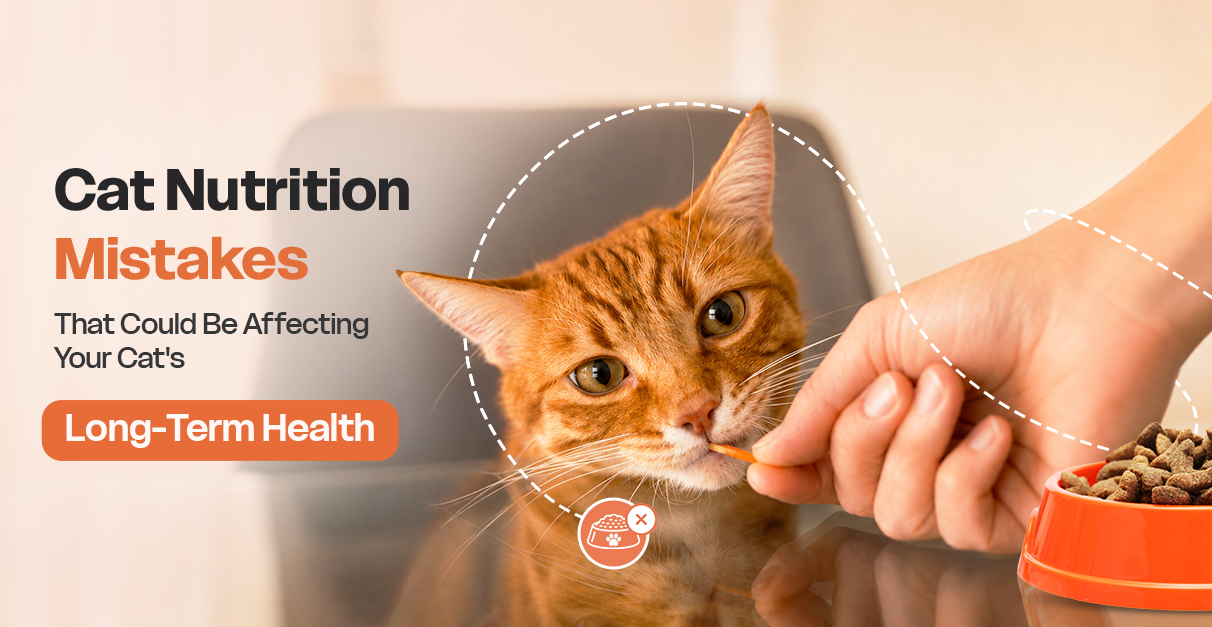
Cats are not small dogs, and they are not small humans either. They are obligate carnivores meaning their biology evolved to run almost entirely on animal protein, with minimal carbohydrates and a built-in resistance to drinking large amounts of water. Feeding them in ways that ignore this biology, even with the best intentions, creates health problems that take years to become visible.Understanding these nutritional differences is important for avoiding common cat nutrition mistakes that can affect your cat’s health over time.
The most damaging cat nutrition mistakes are rarely the obvious ones. They are the small, persistent habits: a bowl left out all day, a food chosen for cost, a supplement added without guidance that compounds over months and years into kidney disease, diabetes, urinary problems, and a shortened lifespan.
Here are the most common cat nutrition mistakes that veterinary nutritionists and feline specialists flag most consistently, and why they matter more than most owners realise.
Mistake 1 : Choosing food based on price alone
One of the most common cat nutrition mistakes is choosing food based on price alone.
Budget cat food is a false economy. Cornell University’s College of Veterinary Medicine is direct on this: cats need high amounts of protein, moderate fat, and minimal carbohydrates, and the quality of the protein source matters enormously.
Low-cost foods frequently substitute quality animal protein with plant-based fillers, by-products, and grain content that cats cannot digest efficiently. The result is that cats eat more of the food to meet their nutritional needs, eliminating the cost saving while simultaneously consuming ingredients that contribute to weight gain, inflammation, and digestive stress over time.
What to look for: the AAFCO statement of nutritional adequacy on the label. The first two or three ingredients should be identifiable animal proteins: chicken, salmon, turkey, beef. If the first ingredient is corn, wheat, or a generic ‘meat by-product’, move on.
Mistake 2 : Free-feeding dry food
Free-feeding dry food is another common cat nutrition mistake that can affect your cat’s weight and overall health.
Leaving a bowl of dry kibble out all day feels like convenience. For a cat, it is one of the most reliable pathways to obesity, which in turn contributes to diabetes, joint problems, and reduced lifespan.
Cats naturally eat multiple small meals throughout the day but they stop eating when they are full if given the chance. When food is always available, many cats eat out of boredom or habit rather than hunger. Dry food is also calorie-dense, and it lacks the moisture content that cats need for kidney and urinary health.
According to PetsViva’s 2026 cat nutrition guide, cats naturally have a weak thirst drive because their wild ancestors obtained most of their hydration from prey. Dry food provides approximately 10% moisture compared to wet food’s 70 to 80%, creating a chronic low-level dehydration that strains kidney function over years.
What to do: switch to scheduled mealtimes, two or three times per day. If your cat has been free-fed for years, the transition requires patience but it is worth making.
Mistake 3 : Feeding exclusively dry food
Feeding exclusively dry food is another cat nutrition mistake that owners should consider carefully.
Dry food is convenient, less expensive, and does not spoil in the bowl. It is also significantly lower in moisture than a cat’s biology requires. The relationship between chronic low moisture intake and feline kidney disease and urinary tract problems is well-established in veterinary literature.
This does not mean dry food should be eliminated entirely. Many cats do well on a mixed diet. But if your cat eats only dry food, particularly if they are a male cat (more prone to urinary blockages), a senior cat, or a cat with a history of urinary issues, transitioning toward more wet food or adding water to dry food is worth the effort.
The cat breeder resource Siamese Cat Breeder notes directly: ‘Wet food is closer to a cat’s natural diet and gets more moisture into them, which matters for urinary and kidney health.’ That is not a marketing claim; it reflects how feline physiology was designed to work.
Mistake 4 : Feeding dog food instead of cat food
Feeding dog food instead of cat food is one of the cat nutrition mistakes that can have serious long-term consequences.
This one sounds obvious, but it happens in multi-pet households usually out of convenience or because the cat keeps stealing from the dog bowl. Dog food is not toxic to cats in a single meal, but it is genuinely harmful as a regular diet.
The critical difference is taurine. Cats cannot synthesise taurine from other amino acids the way dogs can, so they must consume it in their diet. Dog food does not contain taurine in sufficient quantities for cats. Chronic taurine deficiency causes dilated cardiomyopathy (a serious heart condition) and retinal degeneration, both of which can lead to blindness and heart failure.
As OurPetTails notes plainly: ‘Dog food doesn’t contain enough taurine which is why cats should never be fed dog food long-term.’
Mistake 5 : Feeding cooked chicken as a main meal
Feeding cooked chicken as a main meal is another cat nutrition mistake that may seem harmless but can result in nutritional deficiencies.
This one surprises owners because chicken is healthy and cats clearly love it. The problem is that cooked chicken alone without organs, bone meal, and a full supplement profile is not a complete food for a cat.
It is missing taurine in the right quantities. It is missing the vitamin and mineral profile a cat needs. And as a primary diet over months, it causes deficiencies that show up as heart problems, vision loss, and immune dysfunction.
Plain cooked chicken as an occasional treat is entirely fine. As the main source of nutrition, it is dangerous. If you want to feed a home-prepared diet, consult a veterinary nutritionist who can design a genuinely balanced recipe that includes the right ratios of muscle meat, organ meat, bone meal, and supplements.
Mistake 6 : Adding supplements to an already balanced diet
Adding supplements to an already balanced diet is another common cat nutrition mistake that owners should avoid without professional guidance.
Many owners add supplements to their cat’s food with good intentions: fish oil, calcium, and vitamins. The problem is that high-quality commercial cat food is already formulated to be complete and balanced. Adding more of certain nutrients does not improve health; it creates toxicities.
VetCheck24 identifies this as one of the most common hidden diet mistakes: ‘Adding random over-the-counter vitamins or minerals to an already balanced commercial diet can easily create dangerous toxicities.’ Excess vitamin D causes kidney damage. Excess calcium causes urinary problems. Excess vitamin A causes bone deformity over time.
What to do: if you believe your cat needs a specific supplement, discuss it with your vet before adding it. Do not guess.
Mistake 7 : Ignoring the age and health stage of your cat
Ignoring your cat’s age and health stage is also one of the common cat nutrition mistakes that owners can overlook.
Kitten food, adult cat food, and senior cat food are different formulations for a reason. Kittens need higher protein and fat content to support growth. Senior cats need adjusted protein levels, joint support, and often different mineral balances based on their kidney function. Neutered cats have different caloric needs than intact cats.
Feeding a seven-year-old cat the same food you gave it at two years old is not harmful overnight but it means the food is not optimized for where the cat is in its life. Ask your vet at annual visits whether the current food is still the right choice.
Mistake 8 : Treating weight gain as normal
Treating weight gain as normal is another important cat nutrition mistake that can have serious consequences for feline health.
Approximately 60% of cats in the US are overweight or obese, according to multiple veterinary surveys. Owners frequently normalise this because the weight gain is gradual, the cat seems comfortable, and chubby cats are culturally perceived as healthy.
Feline obesity is a serious health condition. It significantly increases the risk of diabetes, arthritis, liver disease (hepatic lipidosis), and urinary tract problems. It also reduces lifespan. A body condition score of 4 to 5 on a 9-point scale is the healthy range if your cat’s ribs are not easily felt under a light coating of fat, they are likely overweight.
PetCare AI’s nutrition guidance feature helps owners track feeding amounts, adjust for life stage, and flag patterns that suggest dietary changes may be needed.