

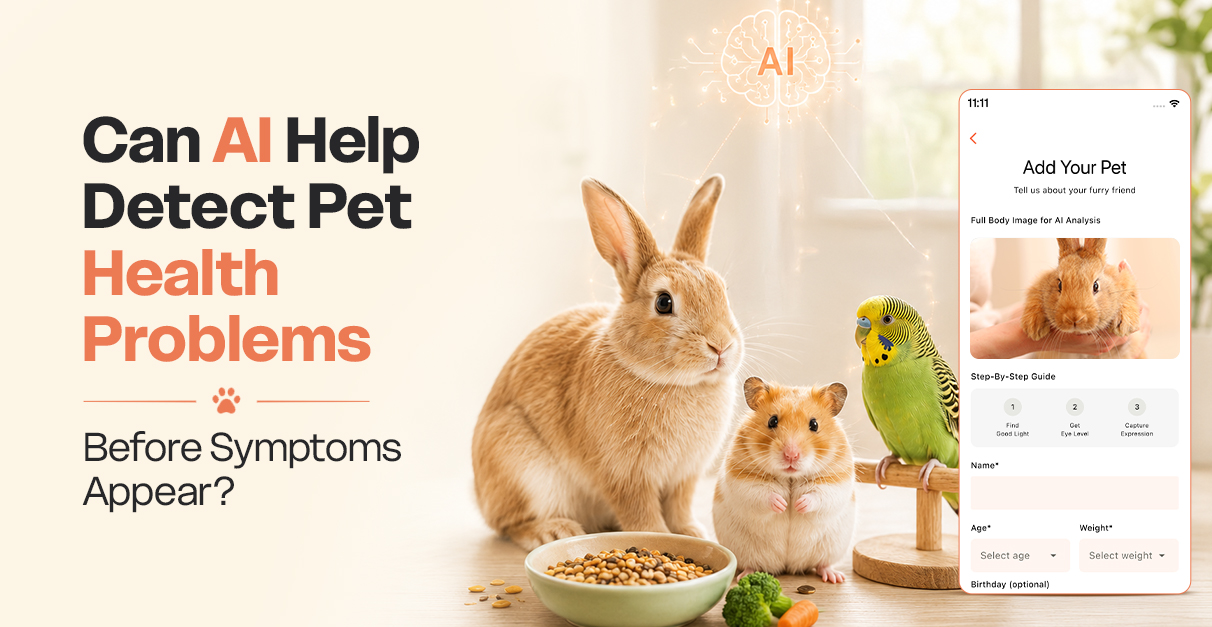
For most of pet ownership history, owners have operated in reactive mode. Something looks wrong, and then they act. The problem with this model is that pets, particularly cats and dogs are skilled at concealing illness until it is well advanced. By the time symptoms are visible enough to prompt a vet visit, the underlying condition has often been developing for weeks.
AI is beginning to change this. Not in a science-fiction way, and not perfectly but in practical, measurable ways that are already available to pet owners in 2026.
Understanding how AI help detect pet health problems can give pet owners a better way to identify potential health changes earlier.
Here is an honest look at what AI can detect, how it detects it, and where its current limitations lie.
What ‘early detection’ actually means in practice
The gap between when a health problem starts and when an owner notices it is called the detection gap. For a condition like chronic kidney disease in cats, that gap can be two years or longer. The disease progresses through stages that are entirely invisible to the eye and only detectable through bloodwork until the kidneys are so compromised that symptoms finally appear.
Early detection means narrowing that gap. Not eliminating it, but shifting the point at which intervention happens from ‘advanced illness’ to ‘manageable condition.’
This is one of the key ways AI help detect pet health problems by identifying subtle changes that may otherwise go unnoticed.
AI contributes to this in two distinct ways: through continuous passive monitoring of behaviour and vital signs, and through structured symptom assessment when an owner actively notices something is off.
Passive monitoring the wearable approach
The most ambitious application of AI detect pet health problems is wearable monitoring. Smart collars and health trackers collect continuous data on activity levels, sleep patterns, heart rate, respiratory rate, and movement quality. AI algorithms trained on large veterinary datasets analyse this data stream to identify deviations from each individual pet’s baseline.
According to Gingr’s 2026 review of AI in pet care, AI-powered wearables have been shown to predict chronic kidney disease in cats up to two years before clinical onset. The Smart Snout reports that predictive algorithms in leading apps can identify potential health concerns up to 14 days before visible symptoms appear, based on subtle changes in eating patterns, activity, and sleep cycles.
The mechanism is pattern recognition at a granularity that human observation cannot reliably match. A dog that circles more before lying down and shifts positions 20% more frequently at night is likely experiencing early spinal discomfort weeks before a visible limp develops. An AI system tracking movement quality can flag this. An owner watching their dog casually probably will not.
These capabilities demonstrate how AI help detect pet health problems through continuous analysis of behavioural and physical patterns.
What AI wearables can monitor in 2026
- Activity levels and daily step counts deviations signal lethargy or pain
- Sleep patterns and quality disrupted sleep often precedes clinical symptoms
- Heart rate at rest elevated resting heart rate indicates stress or cardiac issues
- Respiratory rate changes can indicate respiratory infection or cardiac problems
- Caloric burn and movement patterns reduced activity or altered gait
- Litter box activity (for cats via smart litter boxes) frequency and duration changes signal urinary issues
The SiiPet LitterLens, cited in CES 2026 coverage, can detect urinary crystals in cats before symptoms appear helping owners avoid the $2,000 to $3,500 cost of a urinary blockage that was allowed to develop.
Active symptom triage the AI vet approach
Separate from wearables, AI-powered symptom triage tools take a different approach: rather than passively monitoring, they help owners assess what they are already noticing.
When a dog is limping slightly, a cat has skipped two meals, or a rabbit has been unusually still for a few hours, an owner can describe these observations to an AI vet tool and receive structured guidance the most likely cause given the species, age, and symptom combination, the severity level, and a clear recommended action.
For pet owners, understanding how AI help detect pet health problems also means knowing how AI-based symptom assessment can support faster decision-making.
This approach does not predict illness before symptoms appear. What it does is dramatically reduce the gap between ‘something seems wrong’ and ‘I know what to do about it’ which for most pet owners currently involves a Google search that returns a mixture of panic-inducing worst cases and vague reassurances.
PetCare AI’s AI Vet operates on this model combining the symptom input with species-specific veterinary knowledge to return structured triage guidance within seconds, 24 hours a day.
Where AI detection is most effective today
Conditions with measurable behavioural precursors
Conditions that change behaviour before they change appearance are the best candidates for AI early detection. Arthritis, kidney disease, urinary tract infections, digestive disorders, and cardiac conditions all produce measurable behavioural changes: reduced activity, altered sleep, changes in litter box habits, changed eating patterns before visible symptoms appear.
This makes behavioural monitoring an important area where AI help detect pet health problems at an earlier stage.
Chronic conditions in senior pets
Senior pets are more likely to develop progressive conditions that benefit most from early detection. An 8-year-old dog with slowly developing kidney disease has significantly better outcomes if the condition is identified at stage one versus stage three. Continuous monitoring of a senior pet’s baselines makes trend detection possible over months.