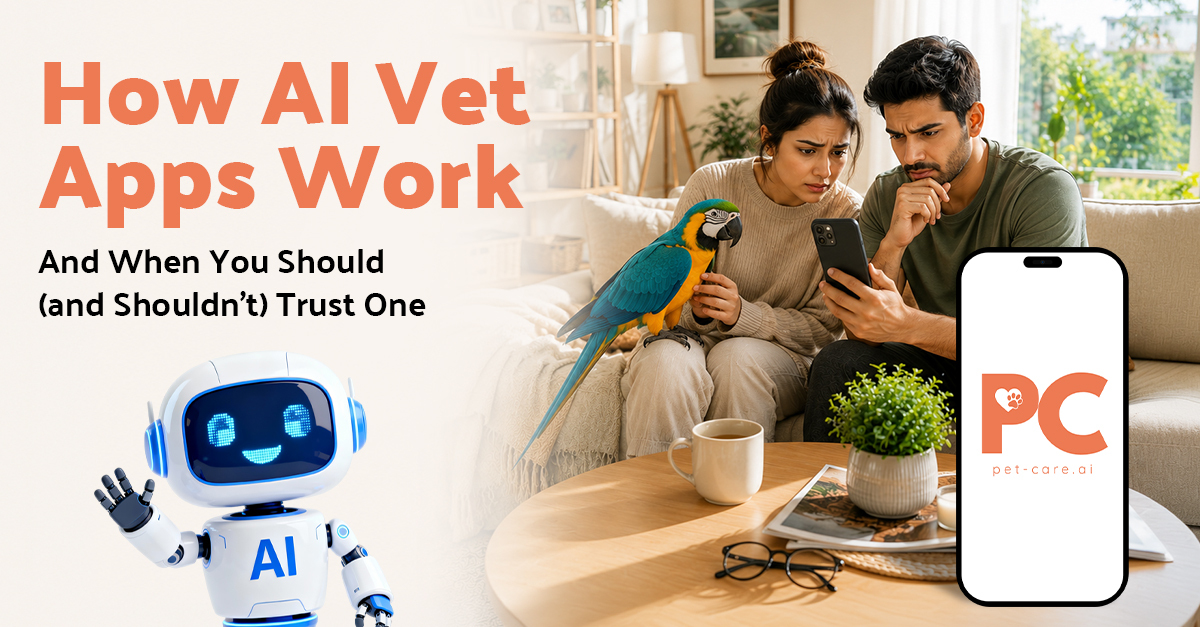
AI vet apps have evolved from niche experiments into practical tools that many pet owners now rely on every day. In 2026, the best pet care apps can analyse your pet’s symptoms based on their species, breed, age, behaviour, and health history, offering guidance that is far more personalised than a standard Google search.
However, not every animal care app offers the same level of reliability. Some provide thoughtful symptom triage backed by veterinary knowledge, while others are little more than generic chatbots using veterinary terminology. Understanding the difference is important especially when your pet’s health is involved.
This guide explains how AI vet apps work, what they can and cannot do, and what to look for when choosing a trustworthy pet care app.
What Does an AI Vet App Actually Do?
At its core, an AI vet app collects information about your pet, such as:
- Species
- Breed
- Age
- Symptoms
- Behaviour changes
- Medical history
- Photos of injuries or visible concerns (where supported)
It then analyses this information and provides structured guidance about what might be happening and what your next step should be.
The best pet care apps don’t simply list possible conditions. Instead, they provide:
- Species-specific and breed-specific insights – A French Bulldog struggling to breathe receives different guidance than a Border Collie with the same symptom.
- Severity assessment – Symptoms are categorised as minor, moderate, or urgent.
- Recommended next steps – Whether it’s home monitoring, scheduling a veterinary appointment, or seeking emergency care immediately.
- Confidence indicators – Showing how certain the AI is about its assessment.
The biggest difference between a search engine and a quality animal care app is decision support. Google may provide dozens of possible explanations for your pet’s symptoms. A good AI vet app helps answer the question that matters most:
“What should I do right now?”
How AI Vet Apps Work
Modern AI vet apps combine several technologies to provide guidance.
Most use large language models trained on veterinary literature, clinical resources, and pet health information. More advanced platforms also incorporate image recognition to analyse visible injuries, pattern recognition to understand symptom progression, and intelligent follow-up questions that refine recommendations based on your pet’s responses.
For example, if your Labrador starts limping late at night, an AI vet app may ask whether there is swelling, whether your dog can bear weight on the leg, or if the injury happened suddenly. Based on your answers, it can estimate whether the issue may be monitored until morning or whether emergency veterinary care is recommended.
The quality of an AI vet app depends heavily on the quality of its training data. An AI model developed primarily using information about dogs and cats may provide less reliable guidance for rabbits, birds, reptiles, or fish.
Before trusting any animal care app, check whether it clearly states:
- Which species it supports
- Whether breed-specific guidance is available
- How recommendations are developed
- Any known limitations
Apps that openly explain these details are generally more transparent and trustworthy.
What AI Vet Apps Do Well?
1. Symptom Triage at Any Time
One of the biggest advantages of an AI vet app is 24/7 symptom assessment.
When your pet develops an unexpected symptom outside veterinary hours, the app can ask relevant follow-up questions and provide a structured severity assessment, helping you decide whether immediate veterinary attention is needed or whether monitoring until your regular clinic opens may be appropriate.
2. Injury Assessment Using Photos
Some pet care apps allow owners to upload images of cuts, wounds, skin problems, swelling, or other visible concerns.
Image analysis may help identify visible wound characteristics, estimate the likelihood of severity, and highlight signs that could indicate infection or deeper tissue damage. However, these assessments should always be considered supportive guidance rather than a medical diagnosis.
3. Better Support for Multiple Species
While dogs and cats have abundant online resources, owners of rabbits, birds, reptiles, fish, guinea pigs, and other exotic pets often struggle to find accurate information.
A comprehensive animal care app that supports multiple species can provide far more relevant guidance than general internet searches.
4. Reducing Unnecessary Emergency Visits
Not every concerning symptom requires an immediate emergency visit.
For example, mild digestive upset or a minor limp may sometimes be monitored safely until the next available veterinary appointment. A reliable AI vet app can help owners make informed decisions, reducing unnecessary stress and avoiding expensive after-hours emergency visits when appropriate.
What AI Vet Apps Cannot Do?
Trustworthy AI tools are honest about their limitations.
No AI vet app can:
- Perform a physical examination
- Listen to your pet’s heart or lungs
- Order blood tests, X-rays, ultrasounds, or laboratory diagnostics
- Prescribe medication
- Replace a licensed veterinarian’s clinical judgement
- Diagnose every condition with certainty
Some illnesses present with similar symptoms but require physical examination or diagnostic testing before an accurate diagnosis can be made.
For this reason, every reputable pet care app should clearly state that its guidance is intended to support not replace, professional veterinary care.
If an app claims to diagnose every illness with certainty or discourages veterinary consultation, treat its recommendations with caution.
How to Tell Whether an AI Vet App Is Trustworthy
Before relying on any AI-powered animal care app, ask yourself these questions:
Does it provide a confidence score?
Reliable AI systems explain how confident they are in their assessment rather than presenting every answer as absolute fact.
Does it clearly state which animals it supports?
An app that claims to support every pet without explaining its training data may not provide equally reliable guidance across different species.
Does it include a clear medical disclaimer?
The disclaimer should appear alongside the assessment—not hidden inside the terms and conditions.
Does it explain what you should do next?
The best apps provide practical recommendations, such as:
- Continue monitoring at home
- Book a veterinary appointment
- Seek emergency care immediately
Does it explain where its guidance comes from?
Trustworthy developers are transparent about whether their recommendations are informed by veterinary literature, expert-reviewed resources, or established clinical guidance.
When Should You Use an AI Vet App?
An AI vet app can be particularly useful when:
- You notice a new symptom and want guidance on what to do next.
- Your regular veterinary clinic is closed.
- You’re unsure whether an emergency visit is necessary.
- You own an exotic pet and need species-specific information.
- You want to track symptoms before an upcoming veterinary appointment.
When You Should Skip the App and Visit a Vet Immediately
An AI vet app should never delay emergency treatment.
Seek immediate veterinary care if your pet:
- Has difficulty breathing
- Collapses
- Loses consciousness
- Experiences severe bleeding
- Has repeated seizures
- Suffers major trauma
- Cannot stand or walk suddenly
- Has severe poisoning or toxin exposure
If an AI assessment recommends urgent or emergency veterinary care, follow that advice promptly.
Choosing the Right Pet Care App
Not every pet care app offers the same level of quality.
Look for an app that provides:
- Species-specific guidance
- Transparent confidence scores
- Image-based symptom support
- Evidence-informed recommendations
- Clear emergency escalation advice
- Honest limitations
- Secure handling of your pet’s information
- Continuous updates as AI technology evolves
The most valuable animal care app isn’t the one that claims to know everything—it’s the one that helps you make informed decisions while encouraging professional veterinary care whenever it’s needed.
PetCare AI: AI Vet Support You Can Trust
PetCare AI is an AI-powered pet care app designed to help pet owners make informed decisions when veterinary guidance isn’t immediately available.
Its AI Vet feature follows five core trust principles:
- Confidence indicators with every assessment
- Species-specific guidance across multiple pet types
- Clear AI-generated recommendations and medical disclaimers
- Practical severity assessments with home care, veterinary, or emergency recommendations
- 24/7 availability without appointments
Whether you’re concerned about a new symptom, a minor injury, or simply need guidance outside clinic hours, PetCare AI provides structured support to help you understand what to do next.
Remember, AI should complement, not replace, professional veterinary care. When your pet’s health is at risk, a licensed veterinarian remains the most important source of diagnosis and treatment.
Start your free 7-day trial of PetCare AI and discover how an intelligent animal care app can help you care for your pet with greater confidence.
Conclusion
This article is intended for informational and educational purposes only. AI-powered pet health tools provide guidance based on the information you share and cannot replace a physical examination or diagnosis by a licensed veterinarian. If your pet is experiencing severe symptoms, difficulty breathing, collapse, seizures, or any other medical emergency, seek immediate veterinary care.